Sunday, July 6, 2014

Film Discussion Entry - Week 6

Throughout the film The Road, the audience gets a sense of how diminished this society has become. Few people are alive, most of them thieves and criminals (with some even resorting to cannibalism), however, our story focuses on a man and his son and the challenges they endure during their quest for survival. They roam the road and seek to travel south. The man is armed with a handgun, but only has 2 bullets remaining in the chamber.
When the man and his son nearly cross paths with a gang, they hide in the bushes, leaving their shopping cart of supplies in the path of the gang. One member takes a bathroom break, and accidentally confronts the man and his son. The man shoots him before he could warn the rest of the gang, but the gunshot obviously being loud gives up their position. They are forced to abandon their supplies and successfully escape the gang at the expense of their remaining material possessions.
The man and his son narrowly escape trouble again, this time by cannibals.
Later in the film, the pair discover a shelter filled with food, and a wide array of other things. However, they leave shortly after due to potential danger. The man later searches for supplies while his son stayed back to observe for danger, but when the boy fell asleep, they were robbed. They encounter the thief, and take back their possessions, leaving the thief with nothing, even without his clothes. When the boy later begs his father for mercy for the thief, the man decides to listen and leaves the clothing and some food for the thief.
After the man is shot by an arrow, they are forced to abandon their cart once again. The man then kills the archer with a flare gun. But when the father realizes he is gradually dying, he expresses the significance of survival and compassion to his son. The man dies, and the boy is left alone. Through this, the audience can see that finally, the boy can now grow into his own man; in the sense that although the father had passed on, the boy will live to learn from the lessons his father instilled in him, regardless of whether or not this society wasn't conventional and post-apocalyptic.
After the man's death, the boy is confronted by a family. Consisting of a man, his wife, their 2 children and a dog, the wife of the family expresses her concern for the boy and asks if the boy would like to join them. The boy reluctantly agrees as the film then fades out.
(Pictured below: The gang that the man and his son hide in the bushes to avoid)

-------

The Hunger Games is a film depicting a severely oppressed society. 75 years before the setting of the film, there was a revolution in the fictional country of Panem. The country is split into 12 extremely poor districts; the capital was far different. After the revolution, a custom (and punishment to the 12 districts) called the Hunger Games was introduced. Each year, every district would choose 2 tributes, one boy and one girl, both of whom must be between the ages of 12-18. These tributes would be transported to the capital and subsequently taken to an extremely large arena where they fight till the death until one remains. The last man (or woman) standing would be crowned victor. The setting of our film takes place during the year of the 74th annual Hunger Games.
In the first few scenes of the film, we already can get a sense of how monetarily deprived this society is. District 12 was not very scenic, and frequently we saw citizens dressed in very plain, non-colorful attire. However, as soon as Katniss Everdeen and Peeta Mellark, the 2 tributes of district 12 head to the capitol, they are shown a life like none they have ever imagined (Katniss volunteered as tribute so her younger sister who was chosen at random would not have to serve as a tribute).
People in the capitol dress extremely colorful, often changing their entire look including makeup simply to focus on one color. (From left to right: Peeta, Effie Trinket (district 12 tribute chaperone) and Katniss pictured above) Trinket, who comes from the capitol, clearly has more style and it seems as though style sort of determines rank in this society.
Meanwhile, Peeta and Katniss board a lavish luxurious train to head to the capitol, where they meet Haymitch (played by Woody Harrelson, aka one of the best actors out there) who won the Hunger Games years before as a tribute for district 12. When they arrive at the capitol Peeta and Katniss are treated like celebrities. They were lodged in an amazing suite, as it seemed as though the tributes deserved to enjoy their life to the fullest at least for a few days before their fight to the death.
All 24 tributes were absolved of their faults (they were waxed, hosed, pimples removed etc), and were dressed superiorly as each pair road in chariots in front of thousands upon thousands of spectators who wanted to see a glimpse of this years tributes.
They trained for a few days and were put in front of sponsors, who gave each tribute a score. The higher the score, the better. Katniss received an 11/12 and Peeta got an 8/12. Sponsors had the ability to give an assortment of things to the tributes during the games, such as medicine, food etc.
When the games started, each tribute was standing on a platform. In the middle of all 24 tributes was the Cornucopia, which at first glimpse had supplies, weapons, and was a common ground for all tributes. See above for pictures of both..Haymitch advised Katniss not to go to the Cornucopia, rather escape and hide in higher ground. She did not listen and almost died in the opening minutes of the games. The opening minutes saw almost half the tributes dead, many fleeing into the woods which spanned for several kilometers. 
Seneca Crane, the gamemaster, was in charge of putting obstacles into the game (ie forest fire, wild beasts, poisoned berries etc). Katniss was to far away from the tributes that formed an alliance, including Peeta, so he used his power to make them cross paths. Thanks to Rue, the little girl tribute from district 11, Katniss was able to find a deadly wasp's nest When the alliance is asleep, Katniss cuts the branch of the nest. The nest fell to the ground and erupted with countless dangerously venomous insects. Another tribute dead. After Rue is killed, Katniss kills her murderer. She makes a ceremonious flower burial for Rue, sparking a riot throughout district 11.
Crane changes a rule, thus allowing 2 victors if they come from the same district. Katniss finds a wounded Peeta and gets him medicine from the Cornucopia. Katniss is almost killed by a girl tribute, however is saved by Thresh, the male tribute from district 11, who showed Katniss mercy for her treatment of Rue. Crane later released wild beasts, which killed Thresh, leaving Peeta, Katniss and Cato as the remaining tributes. While on top of the cornucopia, Cato takes Peeta and Katniss on. He gets Peeta in a headlock, but Catniss shoots an arrow at his hand and Peeta throws him off the cornucopia and he is devoured by the wild beasts.
Crane changes the rule again, only allowing one victor. However, at the moment that Peeta and Katniss are about to take poisonous berries as a means of double suicide so that the Hunger Games had no victor, Crane changes his mind once again, proclaiming them both winners of the 74th annual Hunger Games.

Thursday, July 3, 2014

Essay Analysis Entry - Week 6

In the article Future Almost Lost: Dystopian Science-Fiction Film, the author brings up the fact that "The sublime intensity of The Road...[with] an ashen future landscape that principally expresses itself through the stratified chaos of the logic of sensational social collapse." We can easily tell from the opening scenes of how grim this society is just by looking at the appearance. Little to no life exists, animals cease living, food is extremely scarce, and many remaining humans are dangerous and show signs of cannibalism.
The Man and his son however, had to do what they must in order to survive.
In addition, I agreed with the author's point on how one must die in order for another to really begin their life. The death of the father, in our scenario, is simultaneously the time the son must grow up and learn to live on his own, although the boy is still fairly young.

Monday, June 30, 2014

Film Discussion Entry - Week 5


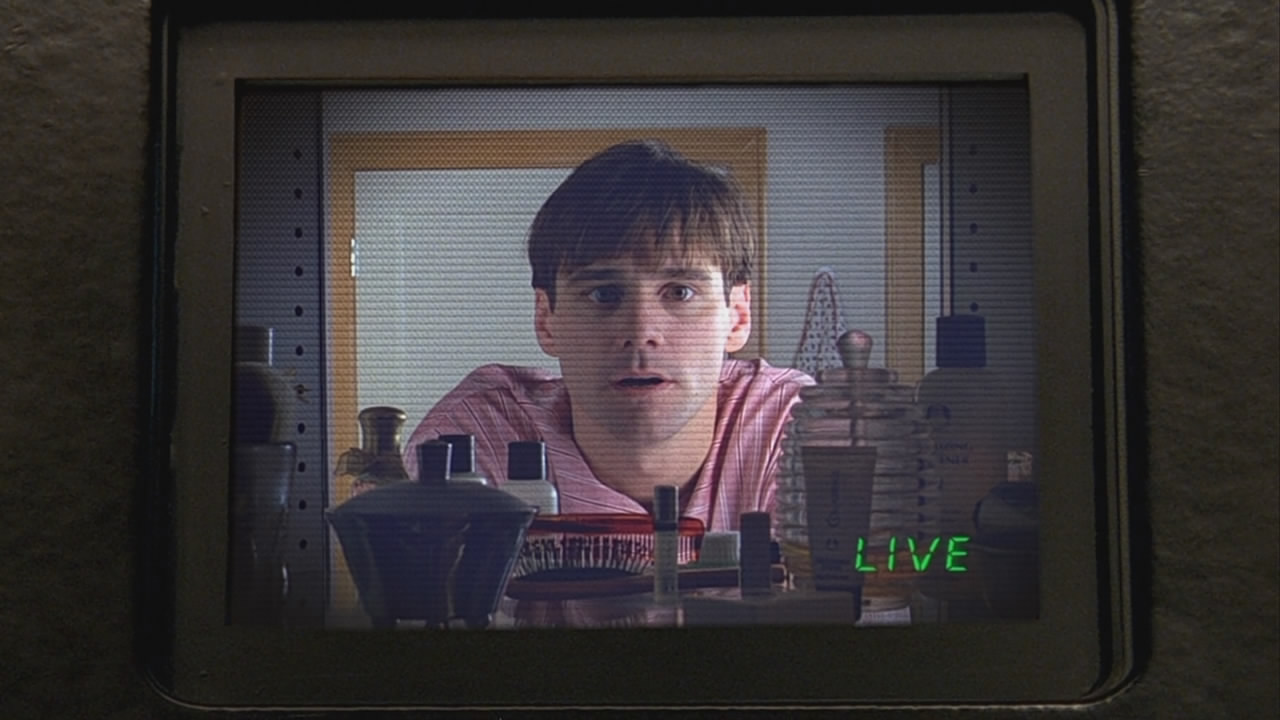
The Truman Show was a film starring Jim Carrey. If you quickly scan through the previous blog post, you will understand that The Truman Show was a TV show broadcasting Truman's life to millions of worldwide viewers. From before he was born, Truman was always the focus of this surprisingly oppressive upside down society. The film helps us, the audience, understand that Truman was the first baby owned by a corporation. The world he grew up in, called Seahaven, was a manufactured dome. Thus, Truman never left Seahaven. His life/TV show went on for more than 10,000 days before he began to realize that weird occurrences were happening in his life, which I guess could be characterized as plot twists. One interesting example was how his wife advertised the cocoa. This kind of gave the idea that an endorsement must have been signed between the television show and the cocoa company. Another crazy occurrence was when he thought he saw his father dressed as a homeless man - his father passed away in a fishing storm accident - however he was forced away onto a bus before they could speak.
These weird instances began a period in Truman's life where he started to question everything and everyone around him. At some point, Truman even tries to leave Seahaven, only to find out that seemingly every possible way to escape the town would not work; the bus broke down, all flights were booked for a month, and even a nuclear radiation scare.
Truman is later able to escape his house, causing the director of the show to temporarily suspend transmission of the previously continuous sequence that was Truman's life. Truman conquers his fear of water and sails to the end of the dome and the front of his boat crashes into the painted background. He sees a flight of stairs and a door marked Exit. Before he walks through, he has a long conversation with the director of The Truman Show, who seemed to 'come to' Truman as though he was a prophet making the director look like Truman's god. Truman decides to leave the dome, and enter the world in which we live in.
An interesting aspect of that scene: To Truman, this was a huge life changing experience. Walking through that door was a big moment in his life, since it took rid of all the things he ever experienced in Seahaven and gave him a chance to experience everything in a new sense. A way to start clean, free to roam the world as he pleases and even visit Fiji! (Fiji water is amazing!!)
However, on the contrary, The Truman Show exemplified simply a TV show to the world, and once he walks through the Exit door, meaning the show is over, people simply tune to a different channel as though nothing really happened to them, which seems to be prevalent.
Lastly, this film ends similarly to Children of Men, since it gives the idea that the film's plot has stopped rather than ended, meaning we never find out how Truman's life faired once he entered the real world.
(Pictured below: Truman on top of the stairs at the edge of the dome)


---------------

In a society where genetic makeup controls it's inhabitants social classes, Gattaca focuses on Vincent, a man who by his societies standards, would be considered genetically inferior. This society deemed 'valids' - people with great makeup - a chance to work in great fields, while 'invalids' had to resort to lower class jobs. When Vincent was born, the audience was able to understand that his estimated life expectancy was just over 30 years; he also had an extremely high probability of various diseases, thus contributing to his inferior genetic makeup, deeming him an in-valid (pictured above).
When they were children, Vincent and his brother Anton used to swim far out until one of them would 'chicken out' and swim back to shore, thus calling this game chicken.
Vincent always had a dream to go to space, but one day figured his dream wouldn't be possible because of the harsh oppressive ways his society called for. However, he later meets a former swimmer named Jerome Morrow. Jerome was in a wheelchair, and decided to give Vincent the chance to be a valid. By using Jerome's urine, blood and hair, Vincent is able to pose as Jerome and get a chance to go to space, fulfilling his lifelong dream. We later find out that Jerome was not drunk when he was struck by a car, thus causing his paralyzation. He rather threw himself before a car as an attempt at suicide due to the fact he was the runner-up in a swim competition.
Less than a week before Vincent's proposed launch date, an important director is killed in the office. Vincent, who's eyelash led a detective to unravel that he is the sole suspect, is able to evade the detection of the detective searching for him. Meanwhile, Vincent begins to spend more time with a girl named Irene, a valid who works closely with him. He also learns that the detective put on the case happens to be his brother Anton. Vincent finds out that Anton knows of his fraudulent activity, and Anton warns him he could be dealing with serious consequences. After arguing, they play one last game of chicken, resulting in Vincent saving Anton. He then is able to use the stars to tell which way was the correct way back to shore.
Vincent bids farewell to Irene and Jerome, and is preparing to go on the spaceship, but he is forced to take one last urine test. However, he does not have any of Jerome's samples. The man in charge of the urine sample, Lamar, finds out that Vincent was an in-valid but let him board the ship anyways because Vincent served as a role model for Lamar's son. Vincent gets on the ship and reads the letter Jerome gave him.
Meanwhile, a powerful scene is endured as Vincent's spaceship launches, while Jerome burns himself to death with his swimming medal.
Pictured below: (Jerome before his death)

Essay Analysis Entry - Week 5

In the article Dark Horizons: Science Fiction and the Dystopian Imagination, Baccolini and Moylan describe 1984, and The Handmaid's Tale and the effects they had on our society. A crucial point later in the article: "Unlike the typical eutopian narrative...the dystopian text usually begins directly in the terrible new world; and yet...the focus is frequently on a character who questions the dystopian society." Throughout our course, we have seen instances like this in many films; for example Montag in Fahrenheit 451, THX 1138 in the film of the same name, and Detective Thorne in Soylent Green, all question their societies means at some point in their respective films.
1984, THX 1138, and Soylent Green all began in the midst of their respective oppressive societies.
After watching The Truman Show, I understood that the above quote is what is generally expected in a dystopian film. The interesting aspect about The Truman Show, however,  is that the film starts off depicting a normal life for Truman, before it is understood that his life was 'purchased' by a Corporation who manufactured a world for him to grow up in. They then subsequently broadcasted his life worldwide, 24/7. Furthermore, one of the reasons i enjoyed watching The Truman Show is because it still displayed a dystopian society, through Truman's viewpoint, but was simply a reality TV show to the millions of viewers in the world.

Monday, June 23, 2014

Film Discussion Entry - Week 4

Children of Men takes place in Britain almost two decades into the future, in a world where infertility has been universally recurrent for 18 years. With little to no hope remaining for the human race, society is awaiting the inevitable, and appears to be in shambles throughout the planet. Britain imprisons all immigrants and recommends its citizens to report any immigrant activity. Our main character, an alcoholic named Theo Faron, is kidnapped by a group called the Fishes. Theo has a history with the Fishes' leader, Julian; they were previously married and had a child named Dylan, who died from a flu outbreak nearly 20 years before. Theo's life is continuously filled with bad breaks and misfortunes, and although it seems that he acknowledges that, he reluctantly agrees to do a favor for Julian. Theo is offered money to acquire transit papers for a girl named Kee (pictured above). He is able to get transit papers. however they require that he escort her. Once they are en route,  Julian is shot and killed, so Luke (member of the fishes) takes Kee and Theo to a safe house. That night, Kee reveals to Theo that she is pregnant! Theo overhears a conversation between Luke and another Fishes member, in which they admitted to killing Julian in order to use Kee's baby as a pawn in the societies uprising. Theo thus convinces Kee to abandon the safe house and accompany him in his quest to bring her to the 'Human Project' a group committed to curing infertility.
Kee and Theo escape to Theo's friends private hidden home, but when the Fishes subsequently uncover the lair, they are forced to flee that safe house as well. They watch in disgust as Jasper, Theo's friend is shot to death by the Fishes. Without a choice, they run away to a school to meet Sid, a friend of Jasper's who will help Kee and Theo break into Bexhill, a detention facility for immigrants, in order to get close enough to the Human Project's boat. Bexhill seemingly incorporates every possible aspect of the word dystopia. Extremely terrible living conditions, paired with copious amounts of violence. It seems as though this world has suffered tremendously in various ways due to the cessation of reproduction, mentally, physically and spiritually. Until meeting Kee, it seems as though every character in this film has no hope.
Furthermore, Miriam, the woman who cared for Kee, was detained by an officer and taken off the bus while Kee and Theo remained on. That night, Theo helps Kee give birth to a girl. Sid finds Kee and Theo but they manage to fight him off and escape. The Fishes capture them, but are under heavy fire from nearby military officials. Theo and Kee are separated, but Theo manages to find Kee in a building. Theo helps Kee walk out of the building, while spectators all try to catch a glimpse of the miracle that is Kee's baby girl. Even the military officials cease fire to witness the living wonder. Theo and Kee are able to get to the boat and he paddles them to a buoy where they await the boat of the Human Project. They then witness the bombing of Bexhill by military jets. Theo gradually dies from a gunshot wound right before the boat appears in the distance. (One of the most moving scenes of the film;
Pictured below: Soldiers cease fire to witness Kee and her baby) The article Film Form and Narrative says the following: "Art cinema also tends to avoid closed endings, favouring instead a sense of irrevolution and indecision. Many art films give the impression that they have 'stopped' rather than 'ended' - that the plot has ceased to dramatize rather than resolve the story's dilemmas." This quote is very applicable to the film Children of Men, regardless if one considers the film to be a sector of art cinema. Once Kee does in fact makes it to the Human Project, the film fades out, meaning we, the audience, never find out how humanity faired after Kee's miracle.

----------------------------------------------------------------------------------------------

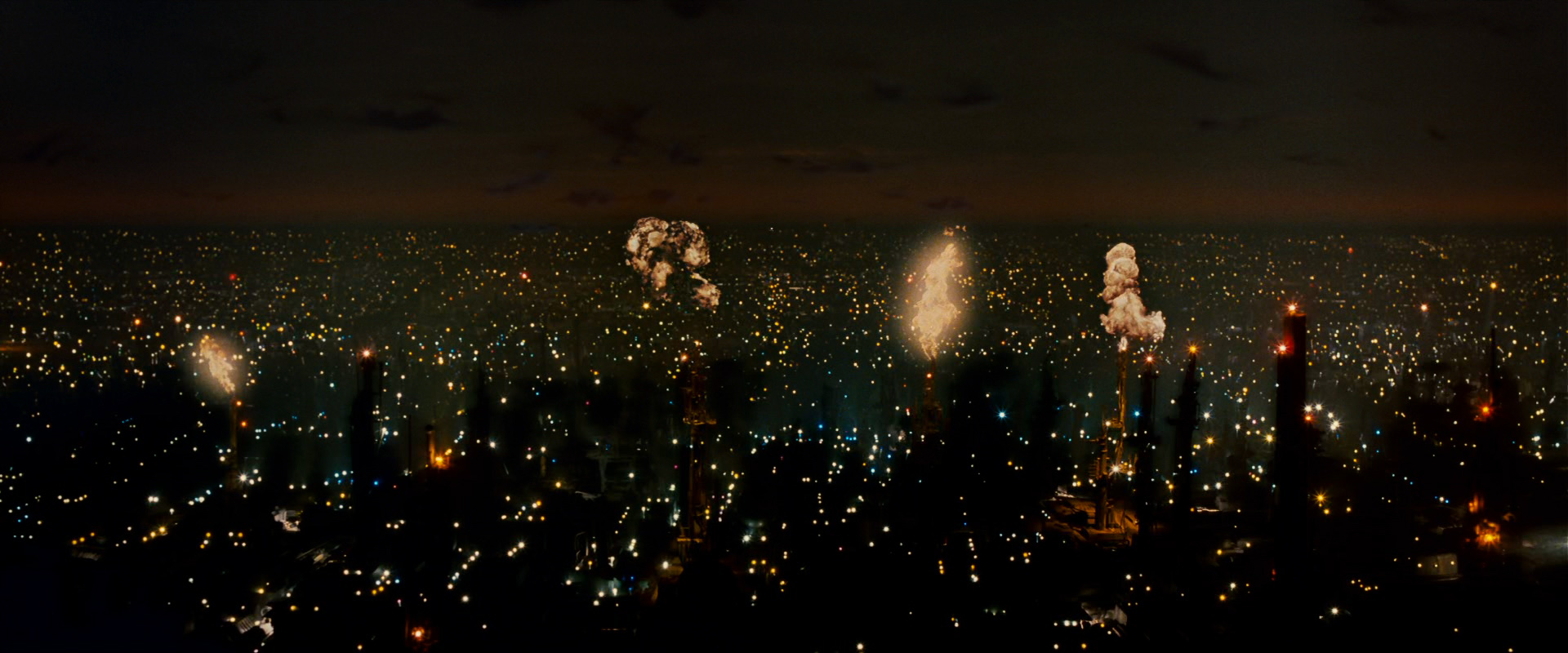
Blade Runner takes place in 2019 in Los Angeles. Released in 1982, this film depicts society with a very appalling appearance. We are told from the opening credits, that Tyrell Corporation has advanced scientific technology on robots to the point where they are equal in intelligence and superior when it comes to strength and agility. Replicants, as these robots are called, could be particularly dangerous, and were deemed illegal on Earth. Special forces called Blade Runner Units were told to kill any replicants they find. "This was not called execution - It was called retirement". From the opening scene, the audience is already informed that killing in this society is a necessity in order to maintain a higher order of balance, thus making death something that may not come as a major shock to its citizens. 
As one could tell from the view of this supposed beautiful 'skyline', this society has a very grim and depressing outlook. We later understand that 6 replicants, 4 currently alive, escaped an Off-World colony and made their way to Earth. Rick Deckard, is tracked down and asked to return to performing his duties as a member of the Blade Runner. He scrutinized the Tyrell Corporation, and then proceeded to investigate the hotel room of one of the proposed replicants, named Leon. He finds a piece of snake skin and is led to a strip club where he encounters Zhora, another replicant. Deckard then shoots her multiple times, killing her instantly. Leon finds Deckard moments later, and Rick mishandles his gun while Leon and him continue fighting. Rachel, the assistant to Mr. Tyrell (Rachel was also perceived by Deckard to be a replicant), picks up Deckard's gun and shoots Leon. Deckard later assures Rachel he will not kill her due to the fact she saved his life.
Roy, the third of the escaped replicants, goes to Tyrell to ask for a longer lifespan, to which Tyrell replies that it can not be done. Roy kills him. 
Meanwhile, Deckard goes to investigate the apartment of Sebastian, a man who works with Tyrell; Sebastian actually 'took in' the fourth replicant (named Pris) because she made him believe she was a homeless orphan. Pris attacks Deckard, but Deckard is able to 'retire' her. Deckard is chased by Roy until they end up on the roof, where Deckard slips but manages to hold a grip to avoid falling. Roy then saves Deckard, but dies slowly due to his lifespan ending. Rick returns to find Rachel asleep, waiting for him.

Thursday, June 19, 2014

Essay Analysis Entry - Week 4

This post will be in reference to the article titled Unmasking the Real? Critique and Utopia in Recent SF Films:
Within two paragraphs of the beginning of the article, the author Peter Fitting makes a very important point regarding dystopian cinema; "to take two extreme examples, a comparison between the dystopian society of Gilead in Atwood's novel and the explanation of how it emerged from our present is very different from the explanation of the dystopian future given in the Terminator movies." This statement is important because it sets boundaries for the different types of dystopian societies in fictional writing/film. Comparing the situation of the Terminator series to a society like Fahrenheit 451, for example, will obviously show an abundant amount of differences, but do they have similarities at the same time? I think one would find it easy to dismiss one as completely unlike the other, but think of them both from the following standpoint: Both are dysfunctional societies, one dependent on a robot sent from the future with an awesome accent (Ahhhnold), and one which follows a strict mindset that anything printed in books must be burned. While they are so different, they do have a likewise problem. In the Terminator, the help of a future robot is what will keep their world alive, while in Fahrenheit 451 we see how Montag's life changed drastically after meeting Clarisse, which led to the betrayal of his wife and employer and his subsequent 'death'. Both societies must survive through events which many may deem questionable. But in the realm of dystopian fiction cinema, the protagonist always has to overcome said questionable events and prevail to help their society thrive instead of continuing to be oppressed in the various ways that our class has showed us.

Monday, June 16, 2014

Film Discussion Entry - Week 3

Fight Club, directed by David Fincher, was released in 1999, but still proves to be an extremely relevant film if compared to our modern day society 15 years later. Starring Brad Pitt and Edward Norton, this film [if completely understood] can change a person's mindset and the way they view life. The beginning of the film helps the audience understand more about the protagonist (and narrator), who remains unnamed throughout the movie. He despises his job, has difficulty sleeping, and seems to be extremely unhappy.
He attempts to get prescribed medication to aid his insomnia, however his doctor refuses to do so, and tells the narrator that if he wants to see real pain to attend a support group for testicular cancer victims. The narrator follows suit, and actually develops an addiction to posing as an impostor at various support groups, even though his physical health is not suffering like the other members.
Meanwhile, the narrator takes a business trip and on his returning flight meets a soap salesman named Tyler Durden. After he returns to his apartment to see that it has been completely destroyed in a fire, the narrator calls up Tyler and soon asks if he can stay with him, which Tyler agrees to. We then find out about how awful the living conditions are, as the power must be cut once it rains, water drips throughout the house, and rusty nails are everywhere.
Soon after, we learn a bit more about Tyler, and how he works as a part-time film projectionist; Tyler manages to sneak a one-frame picture of a penis in between two movie reels which makes the film audience feel uncomfortable even though they only saw it for a fraction of a second. An interesting point, the narrator says that "Tyler is a night person, when the rest of us were sleeping, he worked".
Later, Tyler asks the narrator to hit him as hard as he can due to the fact that they both were never in a fight. They ensue in trading punches and end up beating the crap of one another, and they both love it. Soon after, people from the bar begin watching the 1 on 1 fights and actually volunteer to participate.
The owner of the bar that Tyler and the narrator first fought at is one of the people who decides to join. He allows them to use the basement of his bar as a fighting ring. Tyler lays down the rules of fight club.
Fight club begins to gain traction nationwide, because the narrator begins to take business trips and actually starts fight club in the various cities he visits. Fight club continues to get larger and larger, but nonetheless remains a secret. Things get out of control after Tyler starts Project Mayhem, which is a codename for members of fight club living in Tyler's house and causing utter demolition throughout the city. Tyler then disappears, and the narrator looks everywhere to find him. Then while on the phone with Marla, she calls the narrator by the name Tyler Durden, helping the audience understand that all along, Tyler WAS the narrator. The narrator had a condition called multiple personality disorder, and created the persona of Tyler in his mind.
Go all the way back to the first 5 minutes of the film, the narrator says: 'i know this because tyler knows this'. This sentence, is seemingly a complete giveaway that they are the same person. However, it wasn't really a clear way of understanding that so early in the film. If one couldn't pick it up in that opening scene, they wouldn't really understand that Tyler and the narrator are the same person until way later in the film, in the scene in the hotel room. All along, everything was done by the narrator. Fight club, project mayhem, and the relationship with Marla, all started by the narrator himself, not the fake personality that the narrator created.
Tyler helps explain that he is just a figment of the narrator's imagination. Tyler was everything that the narrator wished he could be. "I look like you wana look, I fuck like you wana fuck, I am smart, capable, and most importantly, I am free in all the ways that you are not". This sentence changed the audience's mindset, as now we see Tyler (the real Tyler, not the fake personality) in the way he really is. We are showed how he fought himself which is what led to fight club being started. One last point, the reason Tyler (the narrator) couldn't sleep in the beginning of the film was because he was too busy being Tyler Durden (the fake one) and staying up late to do his part-time film work and make soap. He also burned his own hand with the chemical powder, which was a crazy thing to imagine in itself.
Towards the end of the film, we understand that fake Tyler put a plan into motion to blow up multiple credit card record buildings which would effectively bring everybody's debt down to 0. The narrator attempts to foil Tyler's plot, but even though they are the same person fails to do so. The film ends with Marla and real Tyler holding hands watching the destruction.

In the article Totalitarian Technocracies, the author says: "There is much to be said about scientific thinking and its potential to elevate civilization. But dystopian writers remind us that most people are ultimately driven by their feelings rather than their intellect, even when their passions cause them to act against their own self-interest". In my opinion, this statement helps put the first few weeks of our course into perspective. Starting with the films Fahrenheit 451 and Soylent Green, both Montag and Detective Thorne, respectively, follow their feelings in both their situations. One to become a part of what he was so against all his life (Montag and the book people), and the other to uncover what their diminished food supply is really made from (Thorne and the Soylent Green factory). In both these scenarios, their passions conflicted their self-interest greatly and even got them into dangerous situations. With the films 1984 and THX 1138 as well, both Winston and THX 1138 decided to stop what everyone else in society was unfortunately conforming to, which also got them into dangerous scenarios. But by following their feelings rather than their intellect, the lives of these characters were dramatically changed.

Throughout the film The Handmaid's Tale, we see a significant theme which is the importance of women in the Republic of Gilead. Some women, the ones dressed in red with a red veil, have two main purposes; To reproduce and to buy groceries. The ones dressed in blue are wives, who administer homes in the neighborhoods. Once the handmaid's give birth, the offspring is overturned to the wives, which is one of the many reasons the handmaid's are severely oppressed.
One interesting point of the movie begins with the title: The Handmaid's Tale.
in order to understand the essence of the significance of the film, one must come to a general understanding of the term handmaid. The definition of a handmaid is: A personal maid or female servant.
Throughout this film, the term handmaid takes on sort of a different meaning; they are responsible for keeping the population from ceasing to exist. Although this movie does not specifically exemplify the conventional sense of the term handmaid, it can be understood that a gruesome reality in this theoretical nation is shockingly prevalent. The severity in which the desire to reproduce in Republic of Gilead went so far that it forbade anyone from leaving the country, which is why our protagonist, Kate, was taken captive as a handmaid, after her husband was shot by the border patrol, and daughter left abandoned. The emotional severity our protagonist must be experiencing is extremely unfortunate, and I'm sure many viewers of this film can relate, personally, in some type of way.
A point in which i feel must be addressed is the lashing of the women's feet when this women refused to follow orders in reference to bearing children. This society, I feel, is very different from the ones we have studied throughout the first few weeks of our DMS course. We have seen many different types of oppressive, dystopian societies, such as one run by fighting and violence, one where technology rules over humans, one where free thought is banned, and even one where reading is strictly forbidden. However, The Handmaid's Tale strikes me a bit differently as the others do, mainly because in this film, the oppression is only targeted to a specific class. Almost all women are sterile, and the few who aren't are treated unfairly and captivated until they go crazy. Men play a small role throughout the movie, which is uncommon, but to be honest, I like the change. I enjoyed seeing how life in its entirety depends on the women whose ability to reproduce has not been taken away from pollution.

Sunday, June 15, 2014

Essay Analysis Entry - Week 3

Even before this class began, Fight Club was easily one of my top 5 favorite movies. The plot, casting, and execution of this film was nearly perfect! The narrator, who's name remains a mystery, tells the audience some facts about his life, such as his suffering of insomnia, and his love for catalog shopping.
His attachment to catalog shopping, he believes, helps portray what kind of person he really is, by choosing one specific coffee table, or one set of dishes over another for use in his kitchen.
In the article titled "Naturalism and Dystopia in Fight Club and Ghost Dog" the author, Wegner, elaborates on the protagonist of the film by explaining how his insomnia takes away from different aspects of his life. He 'finds no reward or pleasure in his work, [and is] detached from everyone around him' (Page 177). Wegner also mentions how the narrator was addicted to support groups, and would frequently attend random groups as an impostor. The narrator does this because he believes when people think your dying, they listen closely instead of just waiting their turn to speak.
This among other reasons help depict Fight Club as a dystopic society that can occur in the present and focus on any ordinary person, rather than in a distant world where members of society are controlled and don't seem like normal 21st century people.
The narrator creates an alter-ego named Tyler Durden, who 'convinces' him to blow up his apartment even though it was filled with all the things he found browsing through catalogs still inside. Later, the narrator and his alter ago's subsequent underground fighting leads to an extremist group that focuses on blowing up buildings containing credit card debt records. By accomplishing this, people will stop being mentally attached to their material possessions.
An interesting side point; on page 178, Wegner explains how once the original Fight Club turns into Project Mayhem, the narrator's alter ego is soon eradicated, resulting in a return to his "middle-class self".

Monday, June 9, 2014

Film Discussion Entry - Week 2

The film THX 1138, is set hundred's of years into the future in a society which is ruled by technology. Some people would describe the past decade as a society in which technology is ruling us. Simply type 'technology ruling our lives' and you can find more than 10 million articles and sources to confirm what you typed into the search box. I would describe our modern day by saying that we incorporate technology into our lives for various benefits; every aspect of our lives seemingly requires some sort of screen. On the contrary, the plot of THX 1138 seems to give off a feel that their society is dominated and ruled by technology, both literally and figuratively. Throughout the film, we encounter many times that everything is run 'through the system' and on the record. People don't have names in the conventional sense, like John or Michael, they are given abbreviated names followed by a four digit number. In this futuristic oppressive society, sex is severely forbidden, and can result in extreme consequences. People are all forced to take medication that seems to take control of their minds. Everyone is bald, and it just happens to seem as though everything is conveniently white, the outfits, the background of almost all the scenes, and the apartments as well. Robots are programmed to rule this society, and they are the only thing that isn't white, their black outfits and chrome makeup don't comply with the white theme that is so prevalent throughout the film.
THX 1138 is employed at a factory which builds robots that serve as the police officers throughout society. His job is extremely dangerous, as he works close to radioactive materials that have potential to cause huge explosions. THX 1138 and LUH 3417, his female roommate, have sex knowing that it is illegal for them to do so. Later in the film, while working at his post, THX 1138 is operating on the robot when his supervisor realizes he is not on the mandatory drugs he was supposed to take, the cause leading him to lose focus and hesitate while on the job. They proceed to play a high pitch noise through THX's headphones, making him unsusceptible to move, a process called "mindlock". This way, THX can be arrested for not complying with the medical requirements. He is successively released but kept in a weird all white 'prison', i use quotations because there were no bars to prevent THX from moving around freely. He, along with 2 other prisoners, escape the prison but are pulled apart by a vicious crowd of people. SEN 5241, one of the other prisoners who escaped, is caught by the police robots. SRT 5752, the third escaped prisoner crashes his car into a support beam. THX drives as far away as he can, leaves the stolen car, and finds a ladder. While climbing the ladder, the ensuing police robots are ordered to stop chasing THX. Once THX reaches the top of the ladder we understand that the city is entirely underground, and the last scene of the film is THX soaking in the view he never got to see before that moment.

In the film Nineteen Eighty-Four, our main character is named Winston. Winston is employed at a place where he rewrites history to the liking of the dictator of the political totalitarian party (Ingsoc), named Big Brother. His face is always portrayed on huge television screens for all the citizens to chant to. Winston buys a notebook and writes down his thoughts, which is a severe crime in this oppressive society. If a person's thought contradicts those of the Party, they can punished harshly. Winston meets a woman who is from the same class as he is, and they begin to have sexual relations secretly. Winston rents a room by means of the same thrift store owner that sold him the notebook, and it is revealed that the owner was actually a member of the Thought Police. The Thought Police seek to find members of society that betray Ingsoc, and in a sense, cleanse them of all their doubts. Winston and his lover are taken into custody; Winston is then tortured by a man who he presumed was also a thought criminal, but in fact was an undercover agent of the Thought Police. Winston is also mentally tortured, in a way that brings out his worst fears out in front of his eyes. His fear of rats is what is used to get Winston to break psychologically and give up Julia, the girl he was having sex with secretly. After he breaks, he is released. Winston then goes to a cafe, where he meets with Julia and they have a drink. He sees a photo of himself on the television, which says that he confessed to various crimes. Before his rehabilitation, Winston told Julia he loved her, however afterwards it was ambiguous to know if he still felt a connection towards her after his release.
The article titled "They Got Me a Long Time Ago" has an interesting paragraph which explains how an unperson, someone executed by the thought police, has fundamentally vanished from society. People are always being watched, by constant surveillance, usually with two-way televisions or helicopters. These secret executions by the Thought Police, in essence vaporize a subject and subsequently the subject is forgotten of. Love, along with free-thinking and facial expression are forbidden in this totalitarian society. O'Brien has always been viewed by Winston as a fellow thought-criminal, someone who was attempting to secretly overthrow the Party and end this vicious regime, but in reality, was just a member of the Thought Police, dedicated to the Party and finding members who don't follow their mind-boggling laws.

Friday, June 6, 2014

Essay Analysis Entry - Week 2

This week, I will discuss "Science, Politics, and Utopia in George Orwell's Nineteen Eighty-Four":

To begin the article, the author starts with an interesting quote. "As M. Keith Booker has rightly observed, science has played a major role in the history of utopian thinking, and especially in the modern turn from utopia to dystopia." The author explains that for centuries, a small group of people held the role of 'experts', such as ancient philosophers and modern-day scientists. These so called experts are seen as the producers of knowledge, meaning they are crucial in the progression of information as we know it. To some degree, this is extremely true. Without science and the people responsible for further evolution of intelligence, where would we be in our 21st century society? I assume it would be comparable to life in the time of Plato, which the author eloquently references. However, later in the piece, the author brings up a solid point: According to J.C. Davis says the author, utopian writers have an inclination to relate the idea of utopia with a perfect society. However, if science is supposed to keep further progressing society, how can a utopian society be improved through scientific advances? Surely, a perfect environment does not need to be further evolved. Science, however, is an ongoing phenomenon; so to say, a point where all knowledge has been attained can't be possible.
Sometimes, when these 2 worlds collide, consequences can be prevalent. For example, the elite class in European 17th century, in this case the Catholic church, clashed with Galileo once his invention of the telescope and his views on the galaxies layout began gaining traction, simply because his views rivaled those of the church. In this scenario, science and the 'producers of knowledge' had different opinions, and the real scientist was punished for having different views than those of the church, even though they were later proved correct. Furthermore, he had to recant his discovery and was subject to house imprisonment for the rest of his life.
Somehow, society must find a way to satisfy its thirst for scientific knowledge while still allowing for an elite group (i guess we'd call them modern-day scientists) to further progress its discoveries. If not, a dystopian twist can occur in our world, but for all our sake, lets hope it never comes to that!!

Monday, June 2, 2014

Film Discussion Entry Week 1 - Soylent Green and Fahrenheit 451

The article explaining Make Room! Make Room!, the novel by Harry Harrington, and the film Soylent Green, are extremely similar, mainly because as it says in the article, the novel was adapted for the film Soylent Green by MGM. Both illustrate horrific living conditions, where people take refuge in the worst possible places. In addition, food and water are rationed, crime is abnormally high, and society is severely oppressed in various ways. Set in the near future (the setting was the year 2022, keep in mind this film was released in 1973), the film depicts a city with over 40 million people who are forced to feed on minimal resources. The majority of Earth is dependent upon Soylent Industries for their food supply, a company who manufactures 'food' out of various organisms from the oceans. As i watched this film, I kept getting the idea that an overpopulated society was way worse than the society from Fahrenheit 451, simply because with so many more people in such a concentrated area, crime would skyrocket, people would starve, and things could easily get out of control. People slept in stairways, on the streets, and packed into the church as well as other places that normally people wouldn't reside. Some women are looked at as 'furniture', meaning they are part of their respective apartment, and are to satisfy each succeeding tenant, similar to a concubine or a courtesan. Poverty is extremely prevalent, and the only way to really live comfortably was if you were rich. Throughout the film, the audience can easily tell that the rich were privileged with things such as AC, real food, liquor, and running water, which nowadays we would call nothing short of a normal household (if you are over 21 that is!).
Detective Thorn, a NYC cop, is assigned to investigate the murder of a Soylent board member named Simonson. When Thorn visits the apartment, he notices a few inconsistencies at the scene of the crime. For example, he observed there was a faulty alarm system; nothing was taken from the loft, even though it was a suspected robbery gone wrong; and the bodyguard was not present at the time of the murder. Thorn was also able to tell that Simonson did not put up a fight.
Later in the film, Thorn is assigned to riot duty, where things get heated in the streets once all the Soylent Green has been consumed. The police call in the scoops, vehicles similar to a payloader. The 'scoops' would literally scoop up members of the mob, and drop them on the back of the truck. This was meant to break up the riot, and actually worked pretty well.
Roth, Thorn's partner, was an older man who didn't do much field work. He did however study up on Soylent and towards the end of the film paid a visit to the exchange, a group of researchers. They confirmed that the ocean is not responsible for what Soylent Green is comprised of, and agree that the processed 'food' is made from human remains. Roth proceeds to go home, (not in the conventional sense, however) a place where he is laid to die while watching a weird video of nature while listening to classical music. Thorn attempts to stop him, however arrives too late. Before Roth dies, he urges Thorn to expose the truth about Soylent Green. Thorn is led to the Waste Plant and witnesses the transformation of dead humans into Soylent Green (i typed evil music into youtube and this was the first thing i found: https://www.youtube.com/watch?v=y8Kyi0WNg40 ).

Fahrenheit 451, a film released in the mid 60s, sheds light on a different type of oppressive society than what we saw in Soylent Green. In F-451, all books have ceased to be manufactured. Possession of any books are strictly forbidden by the government. The typical 'fireman' has an extremely different job in this society, as their top priority is to seek out people who disobey the laws about owning books. Once they are informed of who may be breaking the law by civilians or informants, these so called firemen are sent to the civilians' homes and are allowed to search throughout the home to find the hidden books. Once they unravel any sort of forbidden evidence, the firemen burn all the books (451 degrees fahrenheit is the temperature at which paper will burn, hence the name of the movie) in front of the public. Towards the beginning of the film, Montag, (the protagonist, but more importantly) a fireman, meets a woman on a train that says she believes they are neighbors. From that point on everything about Montag's life changes. The neighbor, Clarisse, asks Montag if he ever reads the books before he burns them. Usually, Montag never gave it much thought and just proceeded to do his sole job of burning the books, however after speaking with Clarisse, Montag decided to begin hiding some of the illegal works in his home, to his wife's dismay. Later in the film, Clarisse narrowly escapes the firemen and tells Montag she is going to run away to the woods to join the 'book people', an underground group that has each member memorize a full book, in order to keep the memory of that book alive. Montag struggles on deciding whether or not to leave, but ultimately has a plan to hide a book in every fireman's home to make the system eat itself from the inside-out. When Montag goes to the Fire Captain and expresses his desire to resign from the force, he is convinced to stay for one last job. Without telling him, Montag's wife informs the firemen of his betrayal, and the last job he goes on happens to be at his own home! The Captain gives Montag the flamethrower and instructs him to burn the books himself. Montag then proceeds to burn the Captain alive, and escapes the other firemen. Montag runs away to the book people, and decides to memorize the Tales of Mystery and Imagination written by Edgar Allen Poe.

When reading the article which compares and contrasts Fahrenheit 451 and Feed, one paragraph stood out among all. "There remains a substantial minority of individuals who secretly hold onto their books, and thus presumably to their humanity. Indeed it is this very fact that makes Montag's job as a fireman possible. Of course, this job continually puts Montag into contact with books and 'book people' ultimately resulting in his own rejection of the official culture of his society and acceptance of book culture." The fact that people in the film hold onto their books, gives them something to live for. Many characters in the film were 'zombies', as Montag eloquently pointed out to his wife and her friends, and one could tell that the people who kept hidden books seemed separated from society, in the sense that they were not only thinking what their government made them think. So to say, the people with books were able to voice their own opinions throughout the film. The fact that Montag was around people who actually thought for themselves, combined with Clarisse and her nosey personality, helped snap Montag out of the oppressed mentality, and into a mentality of life that promoted free-thought and the teaching of books through oral tradition.

In the article On Dystopia, Booker cites Lyman Tower Sargent (a utopian scholar), when describing "coherent terminology for utopian and dystopian fiction". Sargent defines dystopia as 'a non-existent society..that the author intended a contemporaneous reader to view as considerably worse than the society in which the reader lived'. Furthermore, both films Soylent Green and Fahrenheit 451 epitomize the definition which Sargent gave for a dystopian society, as both films incorporate an extremely oppressed society which can easily be viewed as worse than the society in which we live in today.


Sunday, June 1, 2014

Essay Analysis Entry Week 1 - Make Room! Make Room!

Please keep in mind I am referencing the following article:

“The Wretched Refuse of Your Teeming Shore”: Overpopulation and Social Breakdown in Harry Harrison’sMakeRoom!MakeRoom!


This article begins by explaining more about the novel Make Room! Make Room! Terrible conditions are described in the beginning of the article, as it illustrates what society pushed to the edge would feel like in New York City. Growing up in NYC, I can understand what overpopulation may feel like. Anyways, the article describes a society where crime is abundant, food and water is scarce, and many people reside without homes, truly an unpleasant way to live. Later in the article, it says that "by 1970, the number of americans living in or near cities made up 70% of the population". Another unfathomable quote was "6 major cities with populations over 1 million...contributed 30% of the countries major violent crimes". Realistically, overpopulation is seemingly possible at some point, but we have got to start thinking towards the future..what steps would we take (that do not include killing off innocent people) as a city, or as a country in order to avoid such drastic circumstances?

Regarding the setting of the novel, the article explains that the author of Make Room! Make Room!, Harry Harrington, decided on the year 1999, to illustrate to readers that such a future society of overpopulation was absolutely realistically possible in the near future.
Make Room Make Room! shows what future consequences can be, relative to our modern day actions.
While I hope overpopulation does not happen at any point, I do start to wonder how a society like that could function.
But hey, it's science-fiction...you can wonder anythin that your mind wants to imagine.